Abstract
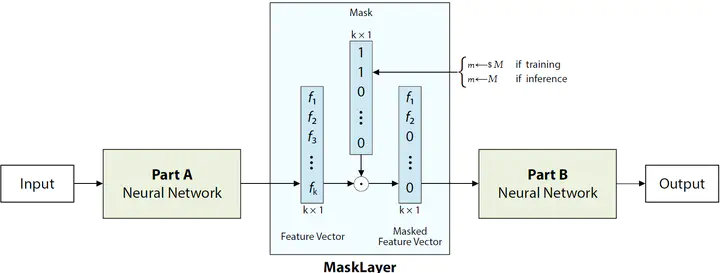
Deep learning-based methods have shown to achieve excellent results in a variety of domains, however, some important assets are absent. Quality scalability is one of them. In this work, we introduce a novel and generic neural network layer, named MaskLayer. It can be integrated in any feedforward network, allowing quality scalability by design by creating embedded feature sets. These are obtained by imposing a specific structure of the feature vector during training. To further improve the performance, a masked optimizer and a balancing gradient rescaling approach are proposed. Our experiments show that the cost of introducing scalability using MaskLayer remains limited. In order to prove its generality and applicability, we integrated the proposed techniques in existing, non-scalable networks for point cloud compression and semantic hashing with excellent results. To the best of our knowledge, this is the first work presenting a generic solution able to achieve quality scalable results within the deep learning framework.

Pengpeng Hu
Senior Lecturer (Associate Professor)
Pengpeng Hu is currently a Senior Lecturer (Associate Professor) with The University of Manchester. His research interests include biometrics, geometric deep learning, 3D human body reconstruction, point cloud processing, and vision-based measurement. He serves as an Associate Editor for IEEE Transactions on Neural Networks and Learning Systems, IEEE Transactions on Automation Science and Engineering, and Engineering and Mathematics in Medical and Life Sciences, as well as an Academic Editor for PLOS ONE and a member of the editorial board for Scientific Reports. He is also the Programme Chair for the 25th UK Workshop on Computational Intelligence (UKCI 2026) and an Area Chair for the 35th British Machine Vision Conference (BMVC 2024). He is the recipient of the Emerald Literati Award for an outstanding paper in 2019.