3DBodyNet: fast reconstruction of 3D animatable human body shape from a single commodity depth camera
Abstract
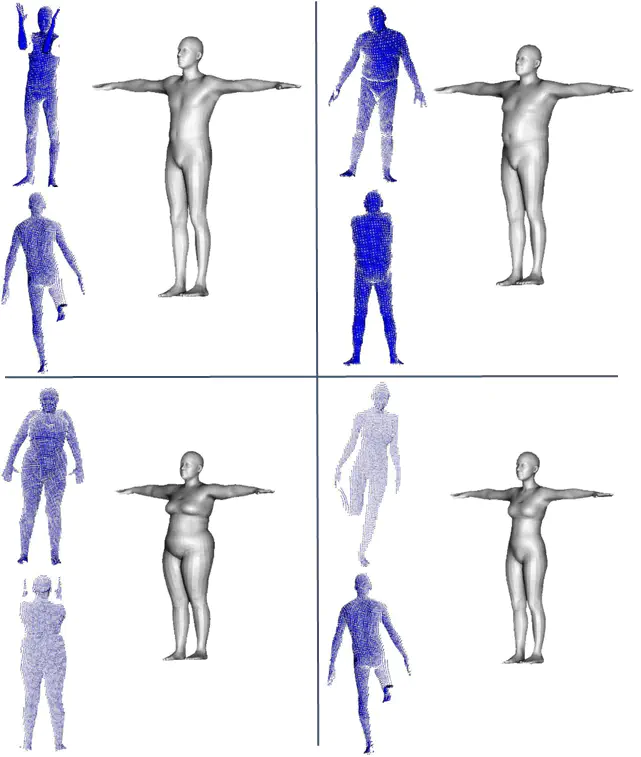
Knowledge about individual body shape has numerous applications in various domains such as healthcare, fashion and personalized entertainment. Most of the depth based whole body scanners need multiple cameras surrounding the user and requiring the user to keep a canonical pose strictly during capturing depth images. These scanning devices are expensive and need professional knowledge for operation. In order to make 3D scanning as easy-to-use and fast as possible, there is a great demand to simplify the process and to reduce the hardware requirements. In this paper, we propose a deep learning algorithm, dubbed 3DBodyNet, to rapidly reconstruct the 3D shape of human bodies using a single commodity depth camera. As easy-to-use as taking a photo using a mobile phone, our algorithm only needs two depth images of the front-facing and back-facing bodies. The proposed algorithm has strong operability since it is insensitive to the pose and the pose variations between the two depth images. It can also reconstruct an accurate body shape for users under tight/loose clothing. Another advantage of our method is the ability to generate an animatable human body model. Extensive experimental results show that the proposed method enables robust and easy-to-use animatable human body reconstruction, and outperforms the state-of-the-art methods with respect to running time and accuracy.

Pengpeng Hu
Senior Lecturer (Associate Professor)
Pengpeng Hu is currently a Senior Lecturer (Associate Professor) with The University of Manchester. His research interests include biometrics, geometric deep learning, 3D human body reconstruction, point cloud processing, and vision-based measurement. He serves as an Associate Editor for IEEE Transactions on Neural Networks and Learning Systems, IEEE Transactions on Automation Science and Engineering, and Engineering and Mathematics in Medical and Life Sciences, as well as an Academic Editor for PLOS ONE and a member of the editorial board for Scientific Reports. He is also the Programme Chair for the 25th UK Workshop on Computational Intelligence (UKCI 2026) and an Area Chair for the 35th British Machine Vision Conference (BMVC 2024). He is the recipient of the Emerald Literati Award for an outstanding paper in 2019.